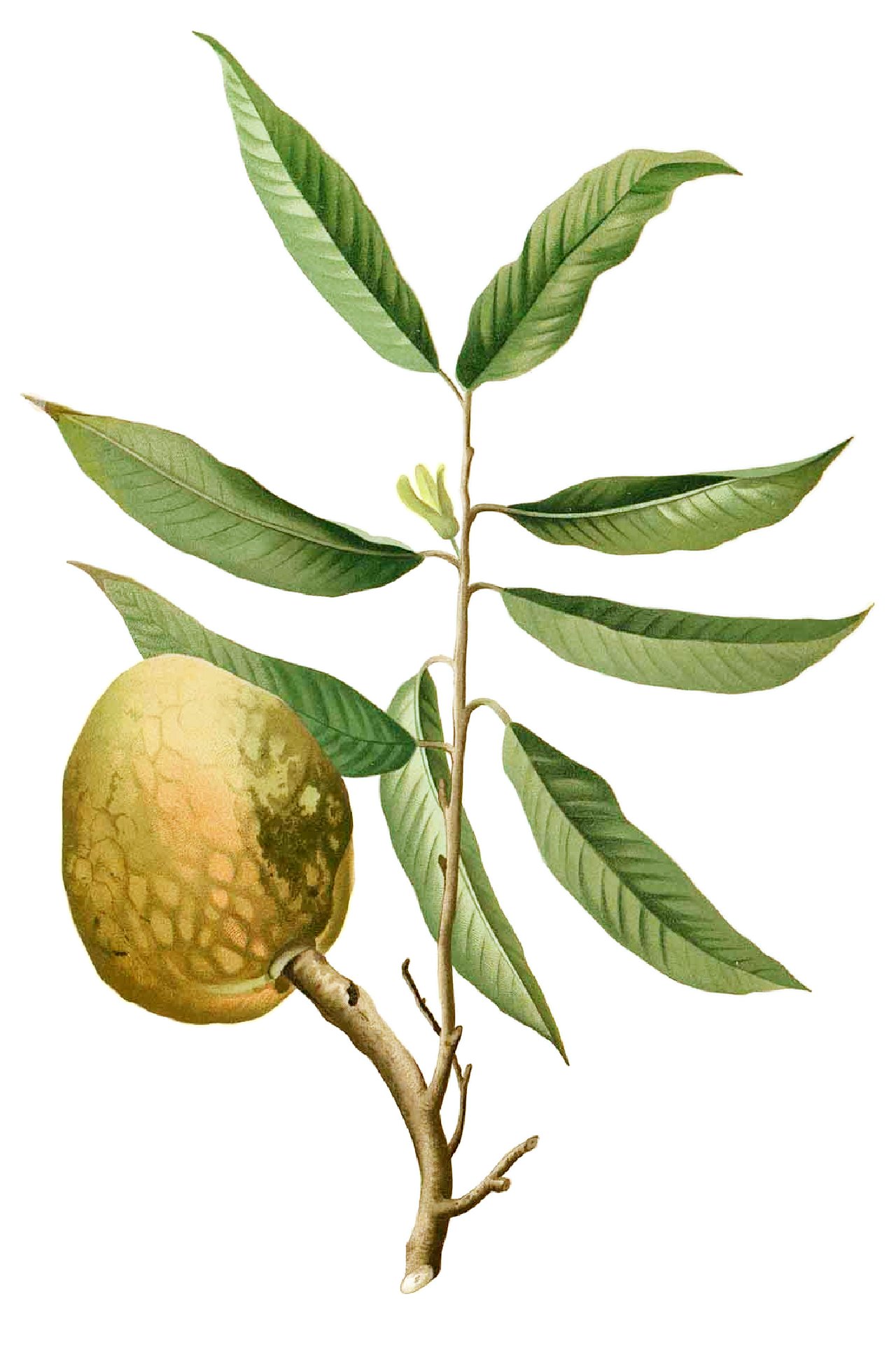
Sugar apple (Annona squamosa) is a small, semi-deciduous tree native to the tropical Americas and widely cultivated across India, Southeast Asia, and Florida. It produces round, green, knobby fruits packed with sweet, aromatic white pulp.
Young trees begin fruiting within 2 to 3 years from seed when given full sun and freeze-free conditions. Cold winds cause rapid leaf loss, so cooler regions require greenhouse or container growing.
Key Facts
- Hardiness: USDA Zones 10 to 11
- Height: 3–6 m (10–20 ft)
- Light: Full sun (6+ hours daily)
- Water: Moderate water while fruiting
- Fruiting Age: 2–4 years from seed
- Toxicity: Seeds are toxic if crushed
Growing Sugar Apple Trees at Home
Sugar apple trees suit warm, frost-free outdoor sites in USDA zones 10 through 11 or sunny, heated greenhouses. They stay compact compared to larger fruit trees, making them manageable in medium-sized urban yards or 57–76 L (15–20 gal) rolling containers.
This tree suits growers who can provide hot summers, reliable moisture during flowering, and complete protection from winter sub-zero temperatures. High humidity aids fruit set, though manual pollination increases yield significantly in urban backyards.
- Requires hot summer temperatures between 25–35 °C (77–95 °F) for optimal fruit set.
- Thrives in container culture where winter shelter is mandatory.
- Enters dormancy and drops leaves during dry or cold winter spells.
Identifying Leaves, Flowers, and Fruit
Sugar apple features alternate, dull-green elliptical leaves measuring 6–17 cm (2.4–6.7 in) long and 2–7 cm wide. Leaves yield a faint resinous scent when crushed and fall off during winter dormancy.
Flowers emerge on short twigs opposite the leaves or in small clusters of 2 to 4. Each flower is drooping, greenish-yellow, 2.5–3.8 cm (1–1.5 in) long, with three thick outer petals that never fully expand. Flowers open for less than 48 hours, transitioning from female to male phase.
The fruit is thick, round or conical, measuring 6–10 cm (2.4–3.9 in) in diameter. It has a rough exterior made of loosely adhering, knobby segment scales that turn pale green or yellowish-green when ripe.
- Flesh: White, custard-like, granular near the skin, divided into juicy segments.
- Seeds: 20–40 shiny dark-brown to black seeds embedded in the pulp.
- Bark: Thin, greyish-brown, with shallow vertical fissures.
Sugar Apple Tree Size and Spacing
Mature sugar apple trees grow to a height of 3 to 6 m (10 to 20 ft) with a canopy spread of 2.5 to 4 m (8 to 13 ft). Their growth rate is rapid in warm weather, reaching up to 1 m (3.3 ft) per year when young.
Space multiple trees 4 to 5 m (13 to 16 ft) apart to allow uniform sunlight distribution and ease of harvest. In high-density plantings, orchardists keep trees pruned to 2.5 m (8 ft) tall for easy hand-picking without ladders.
- Standard spacing: 4.5 m (15 ft) between tree centers.
- Container height limit: 1.8–2.4 m (6–8 ft) with periodic top pruning.
- Root spread: Shallow and fibrous, mostly remaining within the top 60 cm (24 in) of soil.
Ideal Climate and Sun Requirements
Sugar apple requires a minimum of 6 hours of direct, unshaded sunlight daily to initiate flower buds and ripen fruit. Shade leads to leggy branches, sparse flowering, and weak fruit attachment.
This species prefers tropical or lowland subtropical climates with warm spring temperatures above 21 °C (70 °F). High relative humidity (above 70%) during bloom improves pollen germination and fruit set.
- Ideal temperature range: 22–34 °C (72–93 °F).
- Minimum threshold: Sustained growth stops below 15 °C (59 °F).
- Soil pH preference: Neutral to slightly acidic soil between 6.0 and 7.0 pH.
How to Plant Sugar Apple
Plant sugar apple saplings in early spring after all risk of cold weather has passed. Choose a well-drained spot on high ground or a raised bed to prevent water pooling around the collar.
Dig a hole twice as wide as the nursery container and equal in depth. Set the root ball so the original soil line sits level with the surrounding ground, then backfill with native soil mixed with 20% aged compost.
- Water immediately after planting with 10–15 L (2.6–4 gal) of water to settle air pockets.
- Apply a 5–10 cm (2–4 in) mulch layer, keeping mulch 10 cm (4 in) clear of the main trunk.
- Stake young trees for the first season in wind-prone areas to secure tender root systems.
Watering and Fertilizing Requirements
Water young trees twice weekly during the first 3 months, shifting to once every 7 to 10 days during dry summer periods. Reduce watering sharply in late autumn to trigger brief dormancy, which encourages uniform spring flowering.
Apply balanced fruit-tree fertilizer every two months from early spring through late summer. Adequate potassium is critical during fruit swelling to maximize pulp sweetness.
- Spring/Summer feed: 8-8-8 or 10-10-10 NPK with micro-nutrients every 60 days.
- Potassium boost: Apply sulfate of potash during fruit growth stage.
- Drought response: Leaf shed occurs when soil completely dries out for over 3 weeks.
Pruning Sugar Apple Trees for Yield
Prune sugar apple trees annually in late winter while the tree is dormant and leafless. This opens the inner canopy to light and stimulates vigorous new growth where blooms form.
Cut back long, thin shoots by one-third to encourage branching and prevent heavy fruits from breaking weak twigs. Remove all dead, damaged, or crossing branches back to the main branch collar.
- Head back primary branches to 1.5–2 m (5–6.5 ft) to keep harvest height manageable.
- Remove water sprouts and root suckers as soon as they appear.
- Tip-prune new shoots in late spring to trigger lateral branching and secondary flower flushes.
Pests and Common Growing Problems
Annona seed borers (Bephratelloides cubensis) represent the main pest threat, laying eggs inside developing fruits and causing premature fruit drop. Mealybugs, scale insects, and aphid colonies also attack tender spring shoots.
Bag individual fruits in breathable mesh bags when they reach 2 cm (0.8 in) in diameter to block seed borer wasps. Control scale and mealybugs using horticultural oil sprays applied in early morning before sunlight warms the leaves.
- Seed borer damage: Small exit holes in mature fruit accompanied by black internal decay.
- Sooty mold: Black film on leaves resulting from honeydew secreted by scale insects.
- Root rot: Occurs in waterlogged clay soils; plant only in fast-draining media.
Winter Protection and Cold Hardiness
Sugar apple trees sustain severe wood damage when exposed to temperatures below 0 °C (32 °F) for longer than 2 hours. Mature trees drop all leaves below 10 °C (50 °F) but recover if roots remain undamaged by frost.
Wrap outdoor trunks with frost cloth or thermal pipe insulation before expected frost events. For container-grown plants, move pots indoors or into a frost-free greenhouse once night temperatures drop below 12 °C (54 °F).
- Keep soil almost completely dry during cool winter dormancy to prevent root decay.
- Withhold fertilizer from late summer onward to avoid soft, frost-vulnerable autumn growth.
- Unwrap trunk covers as soon as daytime temperatures return above 15 °C (59 °F).
Nutritional Benefits and Fruit Culinary Uses
Sugar apple fruit provides 25 g of natural sugars per 100 g serving alongside rich quantities of vitamin C, potassium, and dietary fiber. The pulp is eaten fresh by separating the knobby segments and spitting out the hard seeds.
The leaves were traditionally used in tea infusions across South Asia and the Caribbean. Note that seeds must never be chewed or crushed, as they contain toxic acetogenins with insecticidal properties.
- Nutrition per 100g: ~101 calories, 25.2 g carbohydrates, 2.4 g fiber, 36.3 mg Vitamin C.
- Pulp preparation: Chilled fresh, blended into ice creams, juices, or smoothies.
- Seed warning: Ingesting crushed seeds causes severe gastroenteritis; seed extracts are historically used to treat head lice.
Year-Round Care for Sugar Apple Trees
| Spring | Prune branch tips before bud break to shape canopy. Resume regular watering as new leaf buds emerge and apply balanced 10-10-10 fertilizer. |
|---|---|
| Summer | Water every 7-10 days during dry weather. Bag young developing fruits with protective mesh bags to exclude seed borer wasps. |
| Autumn | Harvest mature fruits when segment scales turn cream or light yellow. Reduce watering frequency and stop fertilizer applications. |
| Winter | Protect trunks from frost using thermal wraps or move container trees indoors. Maintain dry soil condition while the tree drops leaves and remains dormant. |
Sugar Apple Tree Problems and Diagnoses
| What you see | Likely cause | What to do |
|---|---|---|
| Yellowing leaves falling off in autumn | Natural winter entry or cold shock below 10 °C (50 °F) | Normal winter behavior; withhold water until warm spring temperatures return. |
| Developing fruits turn black, hard, and fall early | Annona seed borer infestation or poor pollination | Bag young fruits in fine mesh bags and perform hand pollination in early morning. |
| White cottony patches on stems and underside of leaves | Mealybug infestation | Spray affected branches with organic horticultural oil or insecticidal soap. |
| Flowers fall off without forming fruit | Low air humidity or lack of pollinators during 48-hour flower window | Mist tree canopy during morning flowering or use a fine paintbrush to hand-pollinate. |
Popular Sugar Apple Varieties and Cultivars
- ‘Lessard Thai’ – green fruit with excellent sweet flavor and lower seed ratio
- ‘Kampong Mauve’ – striking purplish-red skin with pinkish-white pulp
- ‘Purple Sugar Apple’ – dark maroon knobby skin with maroon-tinted pulp
- ‘Cuban Seedless’ – rare cultivar producing small seedless fruits with mild sugar content
Frequently Asked Questions
What is the difference between sugar apple and custard apple?
Sugar apple (Annona squamosa) has distinct, bumpy segments that easily separate when ripe, while custard apple (Annona reticulata) has smoother, brownish-red reticulated skin. Cherimoya (Annona cherimola) features smoother skin with fingerprint-like depressions.
Are sugar apples good for you and how much sugar do they contain?
Yes, sugar apples contain high levels of Vitamin C, dietary fiber, and potassium, though they are high in natural carbohydrates with roughly 25 g of sugar per 100 g serving.
Can you grow a sugar apple tree in a pot?
Yes, sugar apple trees grow well in 57–76 L (15–20 gal) pots filled with sandy potting soil. Keep container trees pruned to 2 m (6.5 ft) tall and move them indoors when temperatures fall below 10 °C (50 °F).
How long does a sugar apple tree take to bear fruit?
Trees grown from seed typically produce fruit within 2 to 4 years under hot conditions, while grafted nursery trees often bear fruit in 1 to 2 years.
Are sugar apple seeds poisonous?
Yes, crushed sugar apple seeds are toxic because they contain toxic acetogenins. Swallowing a whole intact seed usually passes safely, but chewing or grinding seeds releases severe gastrointestinal toxins.
Information about traditional or historical uses is provided for educational interest only and is not medical advice. Do not use any plant to treat a condition without speaking to a qualified professional.
Sources & Verification
Taxonomy and distribution are checked against the databases below. Care guidance is written for cultivated species only and reviewed by our editor. How We Build Plant Profiles →