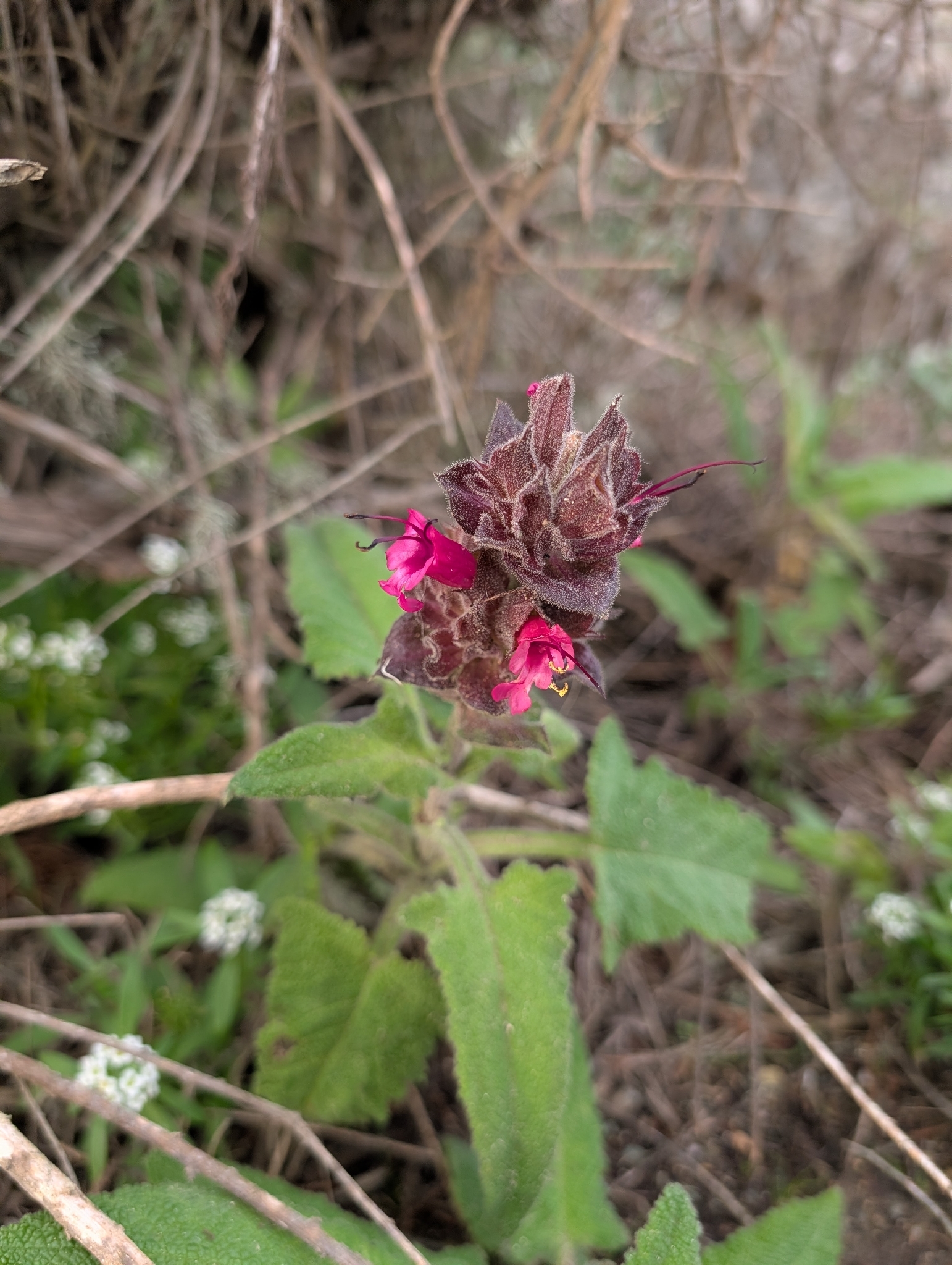
Blood sage (Salvia coccinea) is a herbaceous perennial native to Mexico, the Southeastern United States, Central America, and northern South America. It produces whorls of tubular scarlet blossoms along square stems reaching 45-90 cm (18-36 in) tall.
In USDA zones 8 through 11, plants self-seed readily and persist year-round, while colder climates manage it as a fast-growing annual. Seeds germinate within 10-14 days at temperatures of 20-24 °C (68-75 °F).
Key Facts
- Light: Full sun to light partial shade
- Water: Water when top 5 cm (2 in) soil dries
- Hardiness: USDA zones 8-11; annual elsewhere
- Height: 45-90 cm (18-36 in)
- Spread: 30-60 cm (12-24 in)
- Toxicity: Non-toxic to dogs, cats, and humans
How Blood Sage Fits in Your Garden
Blood sage requires full sun to light partial shade and well-draining soil to perform reliably throughout summer and autumn. This species serves as a mid-height border accent or container plant, attracting hummingbirds and bumblebees from May until the first hard frost.
In warm southern regions like Florida, it self-seeds to form naturalized drifts. It suits gardens seeking low-maintenance nectar sources that survive intense summer heat without leaf scorch.
- USDA Hardiness: Perennial in zones 8-11, annual in zones 3-7
- Height Range: 45-90 cm (18-36 in)
- Bloom Window: May to November (year-round in frost-free regions)
Identifying Salvia coccinea Features
Blood sage forms triangular to heart-shaped leaves measuring 3-6 cm (1.2-2.4 in) long with scalloped margins on quadrangular green or purplish stems. Leaves grow in opposite pairs along hairy, four-sided stems.
The inflorescence consists of interrupted spikes 15-30 cm (6-12 in) long, holding pairs or whorls of 2-6 two-lipped tubular flowers. Wild populations bear scarlet red blossoms spanning 2.5 cm (1 in) long, with a broad notched lower lip and a hooded upper lip.
- Leaf Texture: Softly pubescent (hairy) surface
- Stem Structure: Four-sided (square) cross section
- Fruit: Four nutlets produced per flower containing dark brown seeds
Where to Plant Scarlet Sage
Scarlet sage thrives in 6 or more hours of direct sunlight daily, though light afternoon shade protects blooms in regions where temperatures exceed 35 °C (95 °F). Soil must drain freely; heavy clay causes root rot during humid summer periods.
A soil pH between 6.0 and 7.5 provides optimum nutrient absorption. Sandy loam, gravelly slopes, and enriched beds all support vigorous development.
- Sunlight: 6-8 hours direct sun for dense flowering
- Soil Type: Sandy loam or well-draining garden mix
- Space Requirement: Plant 30-45 cm (12-18 in) apart
Sowing Salvia coccinea Seeds and Planting Out
Sow seed indoors 6-8 weeks before the last spring frost, pressing seeds lightly into moist potting mix without covering them. Seeds require light to germinate.
Maintain soil temperatures at 20-24 °C (68-75 °F); seedlings emerge within 10 to 14 days. Harden off young plants over 7-10 days once night temperatures stay above 10 °C (50 °F) before planting outdoors.
- Sowing Depth: Surface sow (do not bury seeds)
- Germination Time: 10-14 days at 20-24 °C (68-75 °F)
- Plant Spacing: 35 cm (14 in) between plants
Watering and Fertilizing Requirements
Water newly planted blood sage with 2.5 cm (1 in) of water per week until established, then allow the top 5 cm (2 in) of soil to dry between waterings. Mature plants tolerate dry spells, but consistent moisture encourages flower production.
Apply a slow-release fertilizer with a balanced 10-10-10 formula at planting time. Avoid high-nitrogen fertilizers, which promote heavy foliage growth at the expense of blossoms.
- Water Needs: Moderate (drought-tolerant once established)
- Fertilizer Schedule: Once in spring or light monthly feeding
- Mulch Layer: 5 cm (2 in) organic mulch to retain moisture
Pruning and Deadheading Tropical Sage
Trim spent flower spikes back to a leaf node every 3-4 weeks during the summer to stimulate fresh flower spikes. Midsummer shearing by one-third of the plant height prevents woody bases and leggy growth.
Cut stems back to 10 cm (4 in) above ground in late winter in zone 8 and above. In cold zones, leave dried seed heads through autumn if self-seeding is desired before removing dead plants.
- Deadheading: Weekly removal of faded bloom spikes
- Rejuvenation Cut: Trim back by 30% in July or August
- Late Season: Retain seed heads for naturalizing
How to Propagate Blood Sage
Propagate blood sage using softwood stem cuttings in early summer or by harvesting seeds in autumn. Rooting stem cuttings takes 14-21 days in moist soil.
Snip 7-10 cm (3-4 in) non-flowering stem tips, remove the lower leaves, and insert into moist potting mix. For seed collection, wait for flower calyces to turn papery brown, then shake mature seeds into paper envelopes.
- Cutting Length: 7-10 cm (3-4 in) tip cuttings
- Rooting Time: 2-3 weeks in high humidity
- Seed Storage: Dry location in paper envelopes at 4-10 °C (40-50 °F)
Troubleshooting Common Scarlet Sage Diseases and Pests
Powdery mildew appears as white dusty patches on leaves when plant spacing falls below 30 cm (12 in) or relative humidity remains high. Prevent fungal issues by watering at the soil line rather than overhead.
Aphids and spider mites occasionally attack stressed plants during dry conditions. Inspect leaf undersides weekly and treat infestations promptly.
- Powdery Mildew: White spots; fix with better air circulation
- Root Rot: Wilting foliage in wet soil; fix by improving soil drainage
- Spider Mites: Fine webbing; treat with insecticidal soap spray
Overwintering Texas Sage Across USDA Zones
Blood sage overwinters as a perennial in USDA zones 8 through 11, surviving winter temperatures down to -12 °C (10 °F). Apply a 7-10 cm (3-4 in) layer of mulch over roots in zone 8 to guard against frost damage.
In zones 3-7, dig up plants before the first autumn frost, pot them in well-draining soil, and keep under bright light at 15-18 °C (59-64 °F) over winter.
- Perennial Zones: 8 to 11
- Mulch Depth (Zone 8): 7-10 cm (3-4 in)
- Indoor Overwintering Temp: 15-18 °C (59-64 °F)
Bloom Season and Hummingbird Attraction
Flower spikes bloom continuously from late spring until late autumn, producing high-sugar nectar that attracts ruby-throated hummingbirds, butterflies, and bumblebees. Individual tubular blossoms measure 2.5 cm (1 in) long.
Heavy blooming peaks during midsummer when temperatures remain above 22 °C (72 °F). Prompt deadheading of spent stalks prolongs nectar production into November.
- Nectar Value: High sugar content suited for hummingbirds
- Peak Flowering: June through October
- Color Range: Red, pink, and white forms
Best Companion Plants for Blood Sage
Pair blood sage with contrasting sun-loving perennials including yellow lantana (Lantana camara), purple coneflower (Echinacea purpurea), and Egyptian starcluster (Pentas lanceolata). Contrast the red flowers of Texas sage with blue anise sage (Salvia guaranitica).
In pollinator borders, plant alongside anise hyssop (Agastache foeniculum) and red salvia (Salvia splendens) to create varied nectar sources.
- yellow lantana (Lantana camara)
- purple coneflower (Echinacea purpurea)
- Egyptian starcluster (Pentas lanceolata)
- blue anise sage (Salvia guaranitica)
- anise hyssop (Agastache foeniculum)
Frequently Asked Questions
Is Salvia coccinea edible?
No part of Salvia coccinea is widely used for culinary purposes. While non-toxic, its foliage lacks the flavor profile of culinary sage (Salvia officinalis) and is not grown as an edible herb.
What are the traditional medicinal uses of Salvia coccinea?
Traditionally, indigenous groups used infusions of Salvia coccinea leaves in folk preparations for mild digestive discomfort and fever reduction. It is not recognized in modern pharmacology, and readers should not ingest garden plants.
Is Salvia coccinea native to Florida?
Yes, Salvia coccinea is native to Florida and the broader Southeastern United States, extending southward into Mexico and Central America. In Florida, it functions as a perennial wildflower that flowers throughout the year in southern counties.
What is the difference between Salvia coccinea and Salvia splendens?
Salvia coccinea features smaller, slender scarlet flowers on triangular hairy leaves and self-seeds readily, whereas red salvia (Salvia splendens) has larger, denser flower spikes, wider hairless leaves, and originates from Brazil.
How do you harvest and store Salvia coccinea seeds?
Harvest seeds when the calyces turn dry and brown on the flower stalk during late summer. Shake the dark seeds into a paper bag, dry them indoors for a week, and store them in a cool, dark location.
Information about traditional or historical uses is provided for educational interest only and is not medical advice. Do not use any plant to treat a condition without speaking to a qualified professional.
Sources & Verification
Taxonomy and distribution are checked against the databases below. Care guidance is written for cultivated species only and reviewed by our editor. How We Build Plant Profiles →
- Kew Royal Botanic Gardens Plants of the World Onlinepowo.science.kew.org
- NC State University Extensionplants.ces.ncsu.edu
- University of Florida IFAS Extensionedis.ifas.ufl.edu
- USDA PLANTS Databaseplants.usda.gov
- GBIF — Global Biodiversity Information Facilitytaxonomy, synonyms, occurrence records
- Wikipediageneral reference