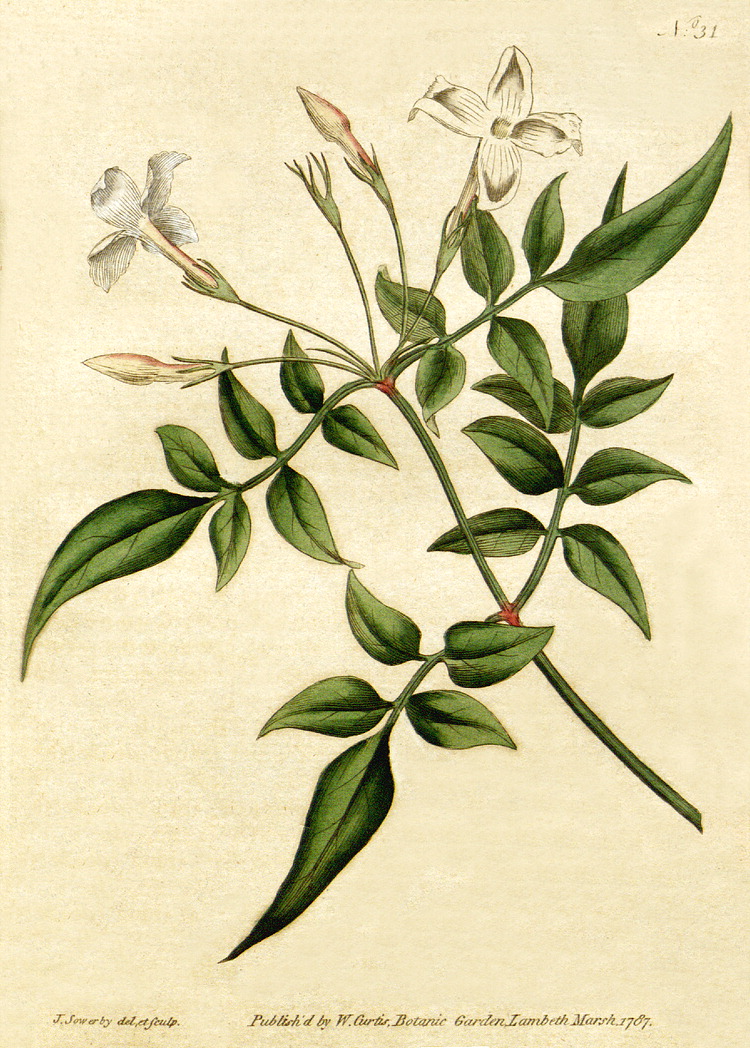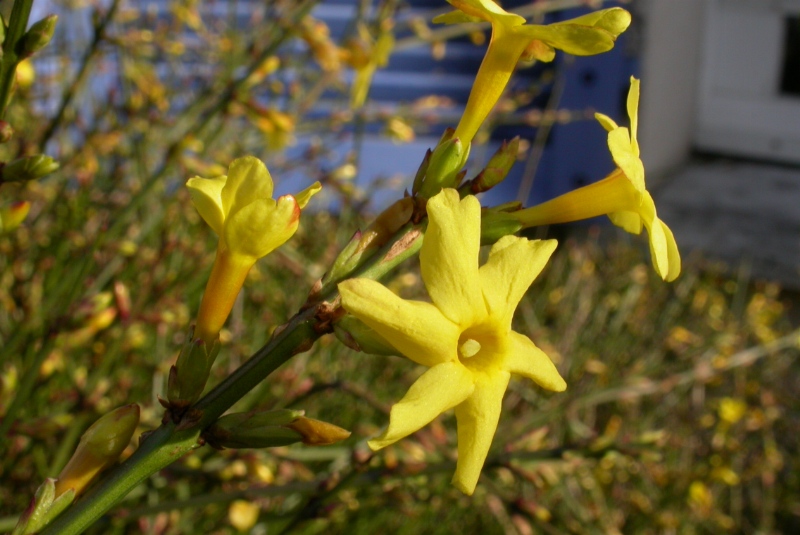
Winter jasmine (Jasminum nudiflorum) is a deciduous rambling shrub native to western China, recognised for producing solitary yellow blossoms along bare, bright green stems in the depths of winter.
Unlike its summer-flowering relatives, this species lacks floral fragrance entirely and does not produce climbing tendrils, requiring manual tying to wires or trellises to grow upwards.
Key Facts
- Flowering period: November to March on previous year’s growth
- Fragrance: entirely unscented flowers
- Pruning time: immediately after flowering ends in early spring
- Aspect: full sun to partial shade; tolerates north-facing walls
- Climbing habit: unsupported scrambler; requires tying to structures
- Hardiness: hardy across USDA zones 6 to 9 (-20 °C)
Is Winter Jasmine Right for Your Garden?
Winter jasmine suits gardeners looking for reliable color between November and March on cold walls, boundary fences, or steep banks.
Because it lacks twining stems, tendrils, or adhesive pads, you cannot simply leave it to climb a wall on its own. It functions either as a fountain-like weeping shrub, a cascading groundcover over retaining walls, or an espaliered wall shrub that you tie in by hand.
It is one of the few shrubs that flowers reliably against a cold north-facing wall, provided the roots do not sit in waterlogged soil.
Winter Jasmine Identification and Appearance
Winter jasmine is identified by its prominently four-angled green twigs and bright yellow, six-petaled flowers opening on completely bare branches.
The plant grows as a loose, arching deciduous shrub reaching 1.5–3 m (5–10 ft) in height and a spread of up to 2.5 m (8 ft) when supported. The leaves appear after flowering in spring and are opposite, trifoliate (divided into three small oblong-ovate leaflets), each leaflet measuring 1–3 cm (0.4–1.2 in) long with a glossy dark green upper surface.
Key botanical characteristics include:
- Flowers: bright yellow, solitary, 2–2.5 cm (0.8–1.0 in) across, featuring 5 or 6 flared lobes on a short tube.
- Stems: slender, four-sided (quadrangular), remaining olive-green year-round.
- Foliage: trifoliate, deciduous, turning dull yellow before dropping in October.
- Fruit: rare in cultivation; paired ellipsoid black berries around 6 mm (0.2 in) long.
Best Planting Position and Aspect
Winter jasmine performs best in full sun to partial shade in any fertile, well-draining garden soil.
A south- or west-facing aspect promotes the heaviest flower bud production and earliest blooms, often opening in November. However, east- or north-facing positions are also viable, making this shrub a staple for dark courtyard walls where other climbers fail.
When selecting a spot, account for its natural arching habit:
- Wall or fence: install horizontal support wires spaced 30 cm (12 in) apart prior to planting.
- Banks and slopes: plant along the top edge so arching branches cascade downwards to suppress weeds.
- Containers: select a pot at least 45 cm (18 in) wide with large drainage holes.
How to Plant Winter Jasmine
Plant container-grown winter jasmine between autumn and early spring, avoiding periods when the ground is frozen or waterlogged.
Dig a hole twice as wide as the root ball and equal to its depth. Position the plant 20–30 cm (8–12 in) away from the base of a wall to prevent the root zone from sitting in the rain shadow of the structure.
Follow these steps to establish the shrub:
- Loosen congested roots gently around the edges of the root ball.
- Backfill with native soil enriched with well-rotted garden compost.
- Firm the soil thoroughly to eliminate air pockets around the root collar.
- Water with 10–15 L (2.6–4.0 gal) of water immediately after backfilling.
- Tie the longest primary stems directly to your support wires with soft twine.
Water and Fertilizer Requirements
Established winter jasmine needs no supplemental irrigation except during prolonged summer droughts lasting longer than two weeks.
During its first growing season, provide 5 L (1.3 gal) of water weekly during dry spells to establish an extensive root system. Plants grown in containers require regular moisture throughout spring and summer, as small volumes of potting compost dry out rapidly.
Feed the plant once per year in early spring directly after pruning. Top-dress the base with a balanced slow-release granular fertilizer such as 7-7-7 at 50 g/m² (1.5 oz/yd²), followed by a 5 cm (2 in) mulch of compost or bark, keeping it 10 cm (4 in) clear of the woody crown.
Winter Jasmine Pruning Time and Method
Prune winter jasmine annually in late winter or early spring immediately after the last flowers fade.
Because flower buds develop exclusively on shoots produced during the current summer, late pruning in summer or autumn will remove the entire winter floral display. Neglected shrubs quickly build into a thick, tangled nest of dead undergrowth beneath a thin layer of living shoots.
Prune using this routine:
- Cut back flowered shoots: shorten stems that carried flowers to strong green buds within 2.5–5 cm (1–2 in) of the permanent framework.
- Tie in replacement stems: select vigorous new green shoots emerging from the base and tie them to support wires to expand coverage.
- Remove old wood: cut one in three thick, brown, woody stems back to ground level to stimulate new basal growth.
- Renovation: cut entirely neglected specimens down to 30 cm (12 in) from the base in April to reset the shrub.
Propagating Winter Jasmine
The easiest method to propagate winter jasmine is by simple ground layering in early summer, as trailing stems root naturally wherever they touch soil.
Bend a flexible, healthy 1-year-old shoot down to the ground, peg it into loose soil with a loop of wire, and cover the midpoint with 5 cm (2 in) of earth. Roots form within 8 to 12 weeks, after which you sever the rooted section from the parent plant and pot it on.
Alternatively, take semi-ripe cuttings in July or August:
- Snip 10 cm (4 in) tips of the current season’s firm green growth just below a node.
- Strip the leaves from the bottom half of the cutting.
- Insert into a 50:50 mix of peat-free potting compost and sharp horticultural sand.
- Maintain high humidity under a clear cover at 18–21 °C (65–70 °F).
Winter Jasmine Winter Hardiness and Care
Winter jasmine easily survives winter temperatures down to -20 °C (-4 °F), matching USDA hardiness zones 6 through 9.
The green stems suffer no damage in typical British or continental winters. While open flowers may brown if exposed to a severe sudden frost below -5 °C (23 °F), unopened buds remain unharmed and continue opening successively whenever temperatures rise above freezing.
For potted specimens in cold zones (zone 6), wrap the pot in hessian or bubble wrap to prevent repeated freeze-thaw cycles from splitting terracotta or damaging peripheral fine roots.
Year-Round Winter Jasmine Care
| Spring | Prune all flowered shoots back to strong outward-facing buds within 5 cm (2 in) of the permanent wood in March or April. Apply a 5 cm (2 in) mulch of well-rotted compost and broadcast 50 g/m² (1.5 oz/yd²) of general fertilizer around the base. |
|---|---|
| Summer | Tie vigorous new green stems to wall wires or trellises using soft garden twine every 3 to 4 weeks. Water container specimens thoroughly when the top 3 cm (1.2 in) of compost dries out. |
| Autumn | Inspect support ties and loosen any that are constricting fattening stems. Stop all feeding by September to allow wood to mature before cold weather arrives. |
| Winter | Cut budded stems for indoor floral arrangements as the buds show yellow color. Protect roots of container-grown plants with insulating wraps if sub-zero freezes persist beyond three days. |
Troubleshooting Common Winter Jasmine Problems
| What you see | Likely cause | What to do |
|---|---|---|
| No flowers in winter | Pruning too late in summer or planting in heavy shade | Prune only in early spring directly after flowering, and move the plant or thin overhanging canopies to increase sunlight. |
| Hollow, tangled center with bare woody stems | Failure to prune annually, allowing outer branches to shade out inner wood | Renovate in April by removing one-third of the thickest woody stems to ground level, repeating over three years. |
| Brown or shrivelled open flowers | Severe overnight frost damaging open petals | No action needed; secondary flower buds will open naturally once temperatures rise above freezing. |
| Yellowing foliage with fine webbing in summer | Two-spotted spider mites during hot, dry spells on sunny walls | Hose down foliage with water to raise humidity, or spray thoroughly with insecticidal soap. |
Winter Jasmine Cultivars
- 'Aureum' – golden-yellow foliage that fades to chartreuse
- 'Mystique' – variegated leaves edged with creamy white
- 'Nanum' – dwarf, slower-growing habit suited to rockeries
Companion Plants for Winter Flowering
Pair winter jasmine with dark evergreen foliage and early bulbs to provide visual contrast against its bare yellow stems.
The bright butter-yellow blooms show best against dark, dense backdrops. Good companion plantings include:
- Sweet box (Sarcococca confusa): provides glossy dark green evergreen leaves and intense winter fragrance at ground level.
- Hellebore (Helleborus orientalis): delivers white, pink, or plum nodding blooms beneath the arching stems of jasmine.
- Snowdrop (Galanthus nivalis): creates carpeted white drifts under wall-trained yellow sprays.
- Winter heather (Erica carnea): blankets the foreground with magenta-pink bells throughout January and February.
Frequently Asked Questions
Does winter jasmine smell sweet?
No, winter jasmine flowers have zero fragrance. If you want a winter-blooming climber with strong scent, choose winter-flowering clematis (Clematis cirrhosa) or pink jasmine (Jasminum polyanthum) indoors.
Is there a white winter jasmine?
True winter jasmine (Jasminum nudiflorum) only produces yellow flowers. If you see a winter-blooming shrub with white fragrant blooms, it is likely winter honeysuckle (Lonicera fragrantissima) or common white jasmine (Jasminum officinale) lingering late.
Can winter jasmine climb walls without support?
No, winter jasmine does not have aerial roots, suction pads, or twining stems to cling to surfaces. You must tie the flexible stems to horizontal wires or a sturdy trellis spaced every 30 cm (12 in).
Can you grow winter jasmine in pots?
Yes, winter jasmine grows well in large containers of at least 45 cm (18 in) diameter filled with soil-based compost like John Innes No. 3. Container plants need regular summer watering and annual post-bloom pruning to keep their size in check.
Is winter jasmine toxic to dogs or cats?
Winter jasmine is non-toxic to dogs, cats, and horses according to the ASPCA. It does not contain hazardous saponins or cardiac glycosides found in false jasmines such as Carolina jessamine (Gelsemium sempervirens).
Sources & Verification
Taxonomy and distribution are checked against the databases below. Care guidance is written for cultivated species only and reviewed by our editor. How We Build Plant Profiles →
- Royal Horticultural Society (RHS)Cultivation profile and pruning advice
- Kew Plants of the World Online (POWO)Taxonomy and native distribution data
- Missouri Botanical GardenHardiness, cultural requirements, and botanical traits
- NC State Extension Gardener Plant ToolboxIdentification characteristics and landscape uses
- GBIF — Global Biodiversity Information Facilitytaxonomy, synonyms, occurrence records
- Wikipediageneral reference